
Signs Your Monolithic Architecture Is Failing Under Load
Our team at ScriptsHub Technologies was engaged by a mid-market healthcare benefits provider whose core enrollment platform had become a critical business liability. The system – a single monolithic application built eight years prior – handled authentication, enrollment workflows, payment processing, document generation, and reporting within one tightly coupled codebase deployed on a single server. What the client needed, though they hadn’t yet framed it this way, was a monolith to microservices migration.
WHY THIS MATTERS
System architecture is not an abstract engineering concern – it is a direct business risk variable. For this client, every hour of platform downtime during open enrollment translated into lost enrollments, regulatory exposure, and eroded client trust. Architecture decisions made eight years prior were now compounding into measurable operational and financial losses.
During the prior year’s open-enrollment window, the platform suffered three full outages over ten days. Concurrent HTTP requests overwhelmed the single server, exhausted the database connection pool, and brought every function down simultaneously. Peak demand reached roughly 4,200 concurrent sessions, yet the enterprise system architecture collapsed above 280. Response times under load stretched to 18-34 seconds against a two-second SLA.
The business impact was severe. Fourteen employer groups escalated formal complaints, three threatened contract termination, and delayed enrollments created potential regulatory exposure under ACA deadlines. The client’s leadership mandated a full remediation before the next enrollment cycle-eleven months away.
CRITICAL SEVERITY
This was not a performance inconvenience – it was a systemic architecture failure creating direct legal, financial, and reputational exposure. The client’s board formally classified the platform as a Tier-1 business risk and mandated remediation before the next enrollment cycle, eleven months away.
Why Did the Enrollment Platform Fail Under Load?
A Monolith to Microservices Migration is the process of decomposing a single, tightly coupled application into independent, loosely coupled services that can be developed, deployed, and scaled individually. In this engagement, the monolith’s architecture made such a monolith to microservices migration essential because every subsystem shared one process, one database connection pool, and one deployment pipeline – meaning a failure in any module cascaded to all others.
Our architecture audit revealed five compounding problems. The platform had zero horizontal scaling capability – only one server instance could run at a time. Business logic was scattered across thousands of interdependent methods with database queries embedded directly in UI controllers. There were no documented API contracts between subsystems. Deployments required full restarts with two-to-four-hour maintenance windows. And seven years of enrollment history sat in a single relational schema.
According to Microsoft’s Azure Architecture Center, monolithic applications become increasingly fragile as they grow because a single point of failure can disable the entire system. This client’s monolith to microservices migration was a textbook response to that pattern, compounded by a hard regulatory deadline that left no room for a gradual approach.
How We Evaluated the Migration Strategy
We evaluated three approaches to remediate the architecture. The comparison below summarises the trade-offs our data engineering team considered before recommending the Strangler Fig pattern-a proven technique for incrementally replacing a live monolith without downtime.
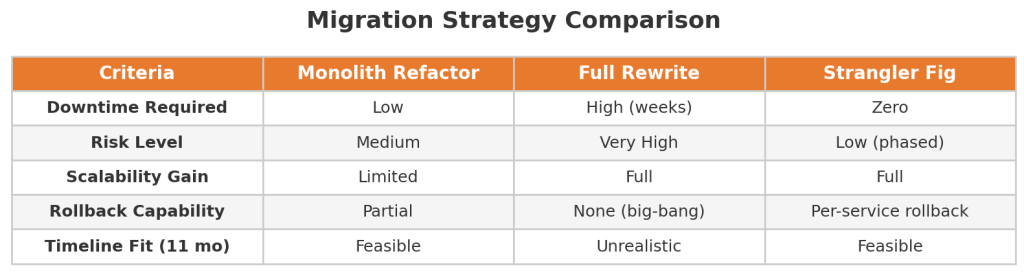
The chosen approach-named after the tropical vine that gradually envelops a host tree- allowed us to extract services incrementally while the monolith continued serving live traffic. Each extracted microservice was validated in production before we committed to the next, ensuring a known-good rollback path at every stage of this enterprise system architecture transformation.
The Fix: Phased Monolith to Microservices Migration on AWS
Our solution was structured across four phases-discovery and domain mapping, foundation infrastructure, service extraction, and load validation-each with defined entry criteria, exit criteria, and a rollback plan.
In the discovery phase, we conducted a three-week architecture audit mapping every module, database table, and inter-component dependency in the existing monolith. This analysis revealed five natural domain boundaries: Identity and Authentication, Enrollment and Plans, Document Generation, Payment Processing, and Notifications. We defined explicit API contracts between domains and established data ownership rules-each service would own its own schema and expose data only via API, never through shared database joins.
The foundation phase provisioned AWS infrastructure: Route53 for DNS, CloudFront CDN for static assets, AWS API Gateway as the unified entry point handling routing, SSL termination, rate limiting, and JWT-based authentication. Elastic Load Balancers fronted each microservice cluster with 15-second health checks. Amazon SQS queues handled all asynchronous workflows. Auto-scaling groups used CPU-based policies-scaling out at 65% utilisation and in at 30%.
During service extraction, we deployed services in order of isolation-Notifications first (lowest coupling), then Identity and Auth, Enrollment, and finally Payments. New endpoints were routed through the API Gateway while the monolith continued serving unmigrated domains. Each service ran on Amazon ECS Fargate with independent horizontal scaling, a dedicated RDS PostgreSQL instance, and a Redis cache layer. Blue-Green deployments ensured every cutover could be reversed within 60 seconds.
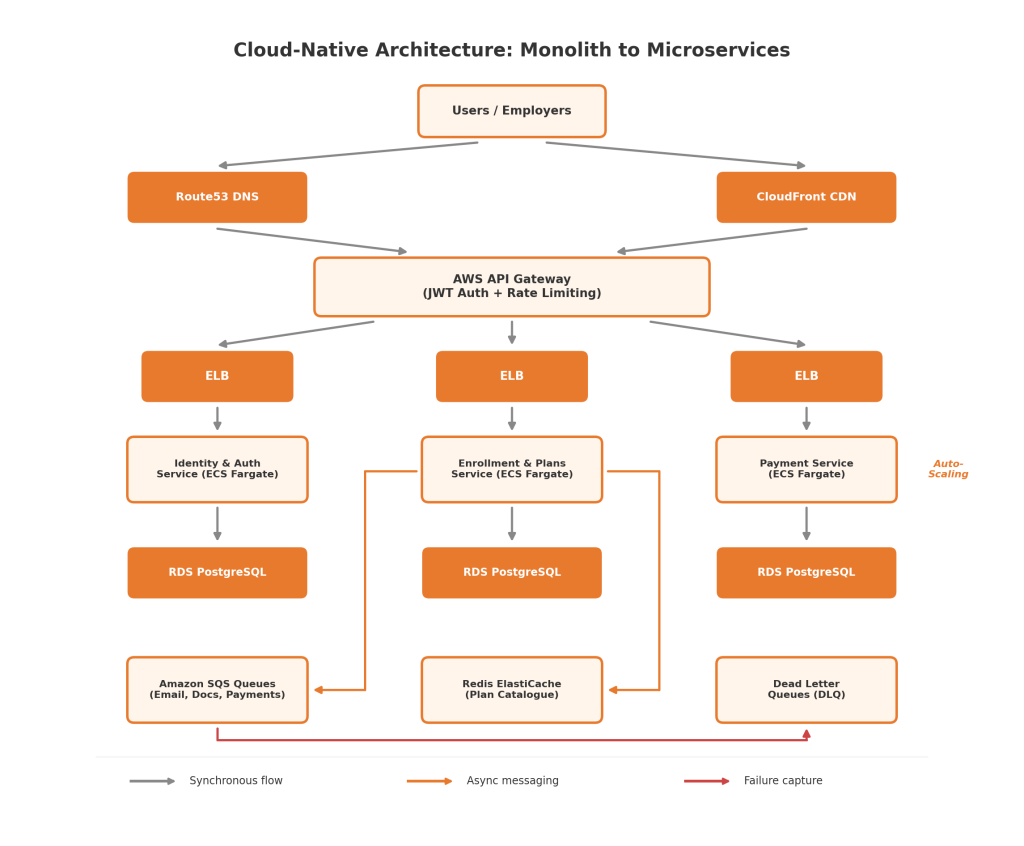
Three synchronous workflows were moved to asynchronous SQS processing with outsized impact: enrollment confirmation emails that previously blocked API responses for 800-1,200 milliseconds, PDF generation that caused two-to-four-second delays, and payment receipt generation. Each queue included a dead letter mechanism to capture failures for inspection and reprocessing.
DLQ IN PRODUCTION
During the first month of operation, the Dead Letter Queue captured 11 failed document generation jobs caused by a PDF rendering library memory leak. Without the DLQ, these failures would have been silently lost. The DLQ allowed the team to identify the root cause, patch the library, and reprocess all 11 documents – with zero user impact.
Validation
We conducted three rounds of load testing using Apache JMeter, simulating 5,000, 10,000, and 15,000 concurrent users. The first round used uniform synthetic request patterns and passed comfortably. The second round replicated actual enrollment workflows-login, plan browse, dependent add, document download, payment submit-and uncovered two critical bottlenecks:
a synchronous document-generation call blocking the enrollment API and an N+1 query pattern in the plan lookup service.
The document bottleneck was resolved by moving generation to the async SQS queue. The N+1 issue was eliminated with Redis caching of plan catalogue data, which stabilised at a 94% cache hit rate and reduced database queries by approximately 16,000 per hour at peak. As Apache JMeter’s official documentation recommends, testing with realistic user behaviour patterns is essential for uncovering production-class bottlenecks.
Final cutover executed during a low-traffic weekend in mid-October-two weeks before the enrollment window. The monolith was decommissioned after a 30-day parallel-run validation with zero critical incidents.
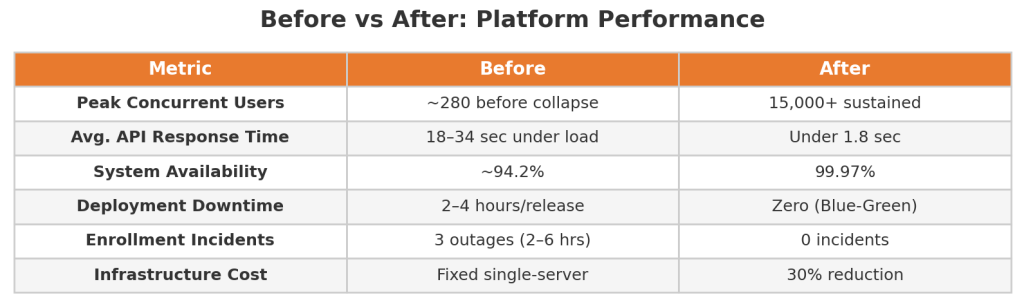
The client’s engineering team independently deployed two new features during the enrollment window-something that had been impossible under the monolith. Three employer groups that had threatened contract termination renewed their agreements, citing the platform improvement as the deciding factor.
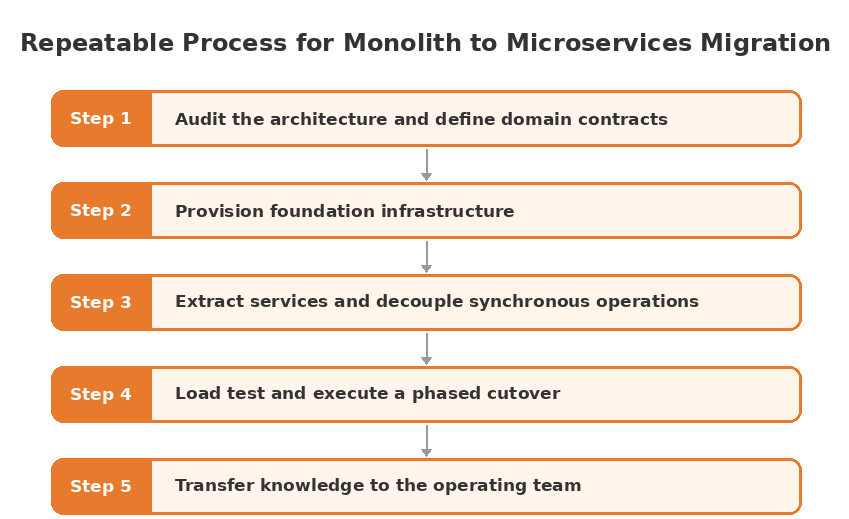
Repeatable Process for Monolith to Microservices Migration
Step 1: Audit the Architecture and Define Domain Contracts
Map every module, database table, and dependency in the monolith. Identify natural domain boundaries, document explicit API contracts between each domain, and establish data ownership rules before writing any new code.
Step 2: Provision Foundation Infrastructure
Set up the cloud infrastructure layer including API Gateway, load balancers, message queues, and auto-scaling policies before extracting any services.
Step 3: Extract Services and Decouple Synchronous Operations
Begin extracting services in order of isolation, routing traffic incrementally while the monolith handles remaining domains. Move the slowest synchronous operations to message queues with failure-capture queues from day one.
Step 4: Load Test and Execute a Phased Cutover
Simulate actual user workflows at progressively higher concurrency to uncover bottlenecks. Deploy during low-traffic windows using Blue-Green or canary strategies, and maintain parallelrun validation before decommissioning the monolith.
Step 5: Transfer Knowledge to the Operating Team
Run enablement sessions covering distributed systems operations, alert configuration, and deployment procedures. Architecture handover is part of the deliverable.
Conclusion
The key takeaway from this engagement is that enterprise system architecture is not a one-time decision-it is a living characteristic of your infrastructure that either enables growth or silently accumulates risk. By executing a disciplined monolith to microservices migration using a phased incremental approach on AWS, we eliminated cascading failures, reduced response times by 91%, and delivered a platform that confidently handles 15× its original capacity. The outcome was a system that survived its most demanding enrollment period on record while giving the engineering team confidence to ship features without fear.
ScriptsHub Technologies specialises in enterprise system architecture, cloud-native migration, and data engineering for clients across the US, UK, and India. If your platform is struggling with scaling failures, deployment bottlenecks, or architecture constraints limiting growth, book a free consultation at scriptshub.net to discuss your specific challenges. Follow us on LinkedIn for more enterprise architecture insights and case studies.
Frequently Asked Question’s
Q. What is a monolith to micro services migration?
It is the process of decomposing a single, tightly coupled application into independent services that can be deployed, scaled, and maintained separately without affecting each other.
Q. What are the signs a monolithic application needs to be replaced?
Common signs include recurring outages under peak load, inability to scale horizontally, deployment windows requiring full downtime, and engineering teams unable to release features independently.
Q. How does the Strangler Fig pattern work for legacy system migration?
The Strangler Fig pattern incrementally replaces a legacy monolith by routing traffic to new microservices one domain at a time while the old system continues handling unmigrated functions.
Q. What is the difference between horizontal and vertical scaling?
Vertical scaling adds resources to a single server, which has hard limits. Horizontal scaling adds more server instances behind a load balancer, enabling virtually unlimited capacity growth.
Q. Why do monolithic applications fail under high concurrent load?
Monoliths run as one process sharing a single connection pool and CPU. A traffic surge in any module exhausts shared resources, causing cascading failures across all functions simultaneously.
Q. What is a Dead Letter Queue and why is it important in distributed systems?
A Dead Letter Queue captures messages that fail processing in an async workflow. It prevents silent data loss and allows teams to inspect, diagnose, and reprocess failed jobs
Q. How long does an enterprise monolith to micro services migration typically take?
Timelines depend on system complexity and team readiness. A phased incremental migration for a mid-market enterprise application typically spans 8 to 14 months including testing and validation.
Leave a Reply