
Quick Summary
A US-based logistics company engaged ScriptsHub Technologies after losing two enterprise clients to a competitor with a more modern platform. Our team diagnosed a tightly coupled Classic ASP monolith with no API layer, single-tenant architecture, and critical security gaps. We executed a phased strangler fig migration to .NET Core and Angular over four months – reducing client onboarding from 14 weeks to three, passing SOC 2 Type II review, and delivering an estimated 2x-3x return on the modernization investment within the first year.
The Challenge: How Technical Debt Was Silently Driving Away Clients
Two enterprise clients lost. A stalled deal worth over $50K in annual recurring revenue. And an engineering team spending 40 percent of every sprint on workarounds instead of features. That was the situation when a US-based logistics company brought in our team at ScriptsHub Technologies to diagnose the problem and lead a legacy app modernization engagement.
The client’s application had been in production for over eight years. It started as a Classic ASP system, received incremental patches in early .NET Framework, and had grown into a monolith that no single engineer on their team fully understood. Their operations staff had built a parallel ecosystem of personal spreadsheets to work around reporting gaps. Their implementation team needed 14 weeks to onboard each new client because the single-tenant architecture required forking the codebase for every deployment. A recent security questionnaire from an enterprise prospect had stalled for four months because session management could not pass SOC 2 Type II review.
The client’s engineering team had flagged these issues for over a year. Two of their senior developers had already started interviewing elsewhere, frustrated by a codebase where every pull request required three reviewers just to catch unintended side effects. The platform was not broken in the traditional sense – it ran every day. But it had become the single largest constraint on their ability to grow. That is when they called us.
The Diagnosis: Why Legacy App Modernization Was Unavoidable
Legacy application modernization is the process of updating or replacing outdated enterprise software to align with current business requirements, security standards, and technology capabilities. In this engagement, the root cause was not a single failure but an accumulation of architectural decisions that had compounded over eight years.
Our team identified four structural problems in the client’s platform. First, the application had no API layer; as a result, all business logic was embedded in server-rendered pages, making integration with third-party systems or modern frontends impossible without custom middleware. Second, the single-tenant deployment model meant every new client was effectively a fork of the codebase, thereby creating an ever-growing maintenance burden. Third, the reporting layer used flat tables with no historical snapshots, which in turn made self-service analytics impractical. We encountered similar pipeline bottlenecks in our ETL optimization engagement where architectural redesign delivered 8x faster processing. Finally, the session management and credential storage patterns predated modern security requirements and, therefore, could not satisfy enterprise compliance reviews.
Each of these problems individually was manageable. Together, they created a platform that was expensive to maintain, slow to scale, and increasingly uncompetitive – the kind of code maintainability challenge that compounds with every quarter of inaction. We have encountered similar compound architectural debt in PHP to Python migration projects and in legacy .NET Framework environments-the pattern is consistent across industries.
Evaluating the Fix: Big Bang Rewrite vs Phased Migration
Two enterprise application modernization strategies were on the table. A complete rewrite would replace the entire application in a single release cycle. An incremental approach using the strangler fig pattern would modernize individual modules while keeping the existing system running.
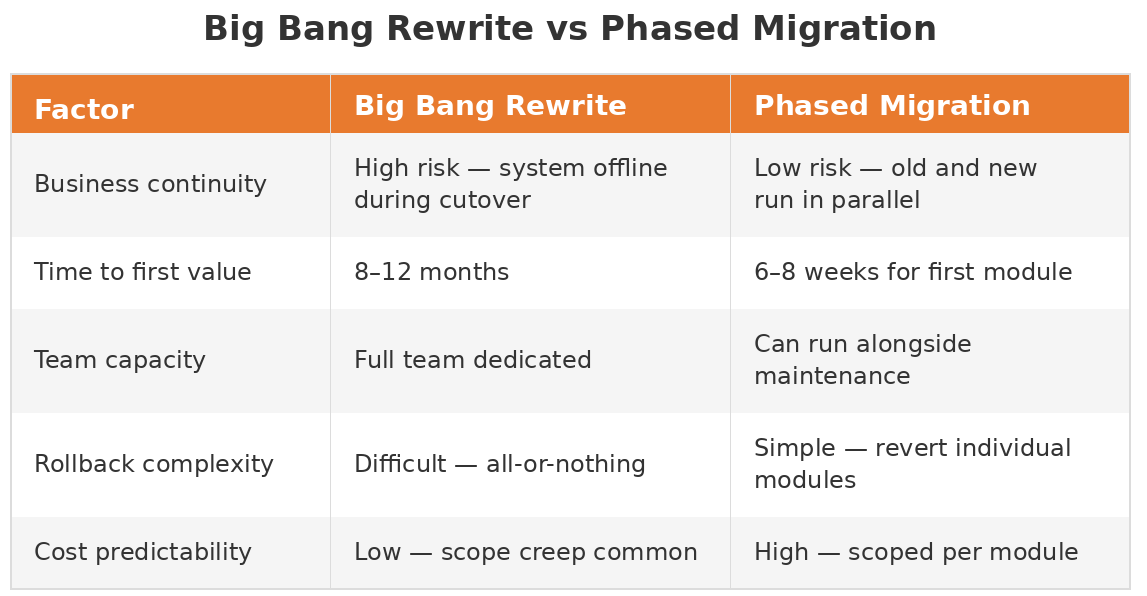
We recommended the incremental approach. The client could not afford to freeze feature development for a year, and the module-by-module strategy allowed us to deliver measurable improvements within the first two months.
The Fix: Phased Legacy App Modernization in Four Stages
The migration ran in four phases over four months.
In Phase 1, we extracted the core business logic from the client’s Classic ASP pages into a .NET Core Web API. This created a clean separation between the data layer and the presentation layer, and gave the client an integration surface that third-party systems could call directly – a core principle of our software development approach. We routed requests incrementally: new endpoints went to the modern API while legacy pages continued serving traffic through the original application.
In Phase 2, we rebuilt the highest-friction frontend modules in Angular. The client onboarding workflow and the operations dashboard were the two modules that generated the most support tickets and workaround spreadsheets. We rebuilt them as Angular components consuming the new API, with parameterized role-based access that supported multi-tenant configuration out of the box.
Phase 3 addressed reporting. We migrated the flat reporting tables into a properly modelled star schema and connected it to Power BI, following the approach we documented in our cross-cloud analytics with Power BI and AWS case study. According to Microsoft’s data modelling guidance, a well-designed star schema with proper relationships and measures can reduce report query times significantly compared to flat table scans. The client’s operations team could now build their own dashboards without waiting for engineering. Our data visualization team designed the data model to support self-service reporting from day one.
Phase 4 was security remediation. We replaced the legacy session management with token-based authentication using industry-standard JWT patterns, moved credentials out of plaintext config files into Azure Key Vault, and implemented rate limiting on all public API endpoints. Cloud-native patterns like these align with the approach we documented in our real-time data with Azure guide.
Validation
Each module ran in parallel with its legacy counterpart for two weeks before cutover. Our team compared outputs to catch regressions, and the client experienced zero downtime throughout the transition. After Phase 4, we commissioned an external penetration test against the SOC 2 Type II requirements that had blocked the previous enterprise deal. The application passed without critical findings. This technology refresh approach gave the client’s leadership confidence that modernization would not disrupt active revenue operations.
The Outcome: Measuring ROI on Legacy App Modernization
The results clearly validated the module-by-module approach to platform modernization. Specifically, client onboarding dropped from 14 weeks to three weeks. Meanwhile, ad-hoc reporting requests to the engineering team fell by over 70 percent, as operations staff built their own dashboards – a direct result of the data analytics foundation we put in place during Phase 3. Additionally, the stalled enterprise deal closed within six weeks of passing the security review. As a result, engineering sprint capacity freed from workarounds increased by 30 percentage points, mirroring what we have seen in Azure Synapse pipeline optimization engagements, where removing architectural bottlenecks has an outsized impact on team velocity. Notably, two senior engineers who had been exploring external opportunities chose to stay.
For the client’s leadership team, the most important metric was return on investment. We worked with their finance team to estimate the business impact across four categories: first, recovered revenue from the enterprise deal that closed post-migration; second, reduced client churn risk; third, engineering labor savings; and finally, avoided recruitment costs. As a result, the table below summarizes the estimated first-year ROI.
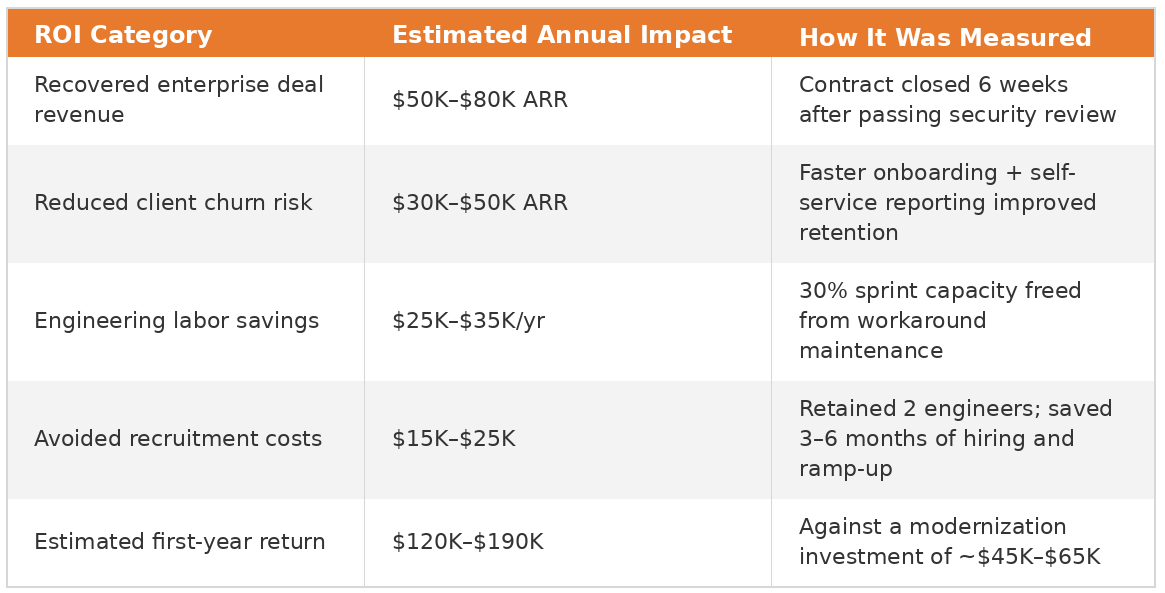
Based on these estimates, the modernization delivered a return of up to 3x within the first twelve months. The payback period was under six months. For the CEO, the decisive factor was the recovered enterprise deal – a single contract that would not have closed without passing the SOC 2 security review. For the CTO, the engineering velocity gain was equally significant: 30 percent more sprint capacity directed toward features that drive competitive advantage rather than maintenance that merely preserves the status quo.
Our Approach: The ScriptsHub Modernization Framework
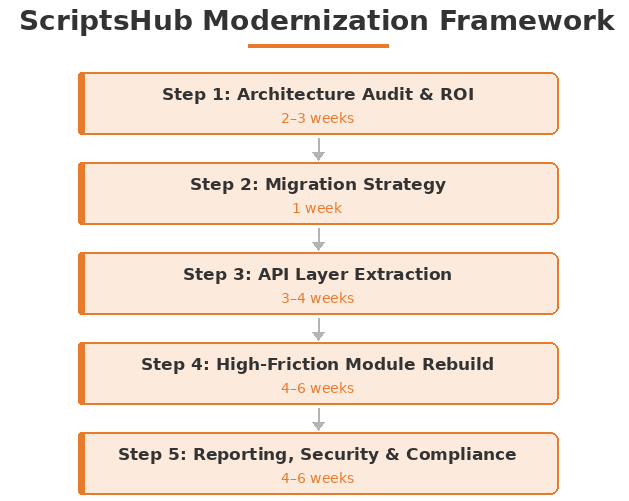
Every legacy app modernization engagement we deliver follows a structured five-step framework. For example, we used this same process for the logistics client above, while adapting it to each organization’s architecture, compliance needs, and business constraints.
Step 1: Architecture Audit and ROI Projection (2–3 weeks)
We map every integration point and workaround in the existing system, then quantify the business impact – lost revenue, churn risk, and engineering costs. The output is an executive business case that frames modernization as a financial decision, not a technology ask.
Step 2: Migration Strategy Selection (1 week)
We evaluate big bang rewrite versus phased migration based on business continuity needs, team capacity, and risk tolerance. Most engagements favour phased migration for its lower risk profile.
Step 3: API Layer Extraction (3-4 weeks)
Step 4: High-Friction Module Rebuild (4-6 weeks)
We prioritize modules by support ticket volume and workaround frequency, rebuilding each as a standalone release with parallel operation before cutover.
Step 5: Reporting, Security, and Compliance Validation (4-6 weeks)
We migrate reporting into a modelled warehouse connected to Power BI, then harden authentication, credential storage, and API security. An external penetration test closes the loop against the client’s compliance framework.
Conclusion
If your platform is losing deals, bleeding engineering hours to workarounds, or failing security reviews – that is exactly the kind of problem ScriptsHub Technologies solves. We have delivered phased modernization engagements across logistics, education, and SaaS,and our full-stack development team is ready to assess your platform.Book a free consultation at scriptshub-cms.azurewebsites.net/ to get a migration roadmap tailored to your architecture and business goals. Follow us on LinkedIn for more case studies like this one.
Frequently Asked Question’s
Q. What is legacy app modernization?
Legacy app modernization updates outdated enterprise software to meet current business, security, and technology requirements; specifically, it uses strategies like phased migration or full rewrites.
Q. What ROI can a company expect from legacy app modernization?
Organizations typically see up to 3x first-year returns from recovered revenue, reduced churn, engineering labor savings, and avoided recruitment costs, with payback periods under six months.
Q. How long does an enterprise application migration take?
Most incremental modernization projects deliver the first updated module within six to eight weeks, with full platform modernization typically completing in three to six months.
Q. What is the strangler fig pattern for software modernization?
The strangler fig pattern incrementally replaces legacy components with modern equivalents while both systems run in parallel, eliminating the risk of a full cutover.
Q. What if the phased migration takes longer than expected?
Each module is independently scoped and deployed, so delays in one phase do not block others or disrupt the live system.
Q. How does legacy app modernization reduce technical debt?
Modernization replaces tightly coupled, undocumented code with modular, well-architected components, thereby making systems easier to maintain, test, and extend.
Leave a Reply